|
|
|
|
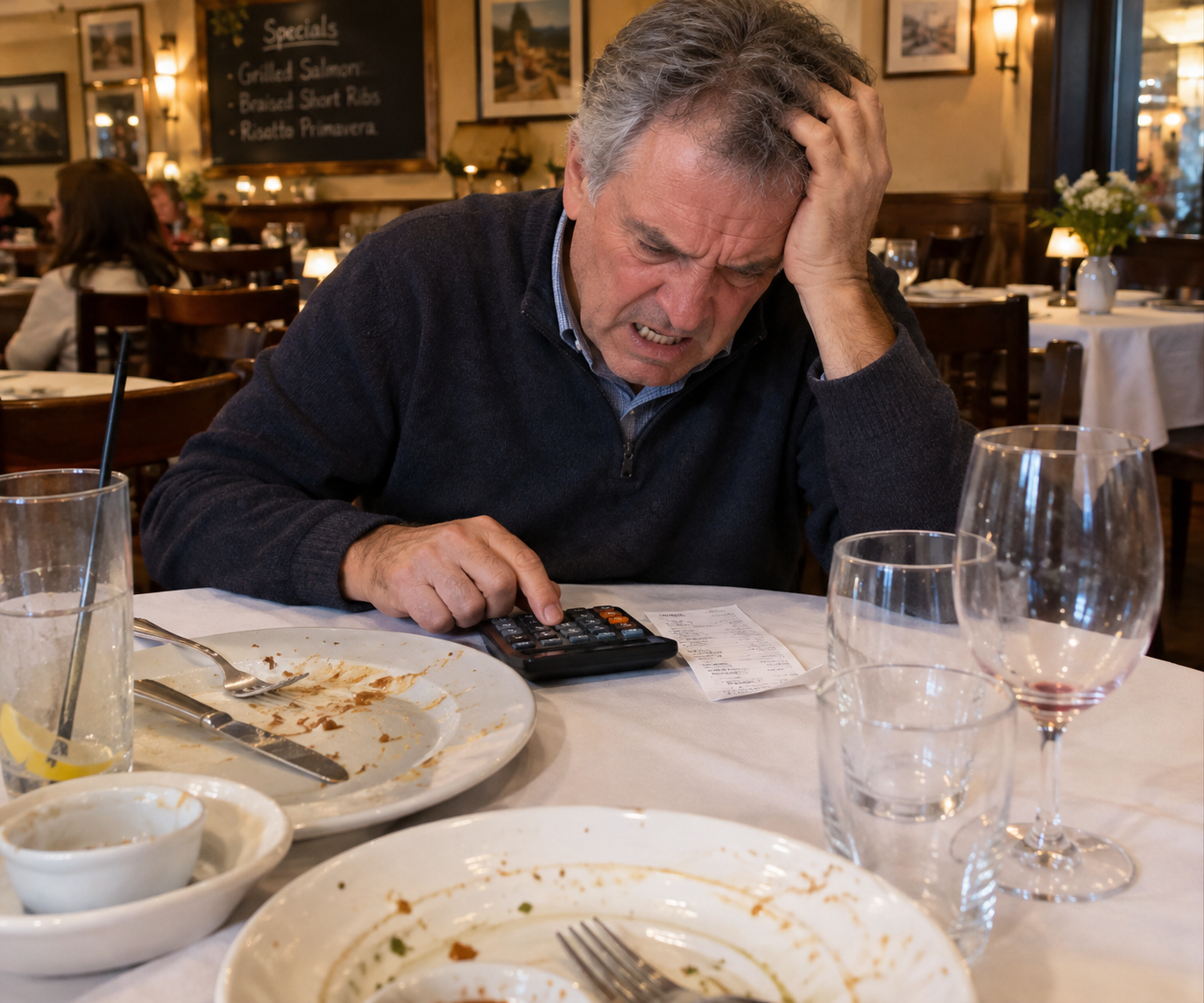
On many occasions, we have remarked on how different it is to eat out in the United States and in France. Because we split our time between Chapel Hill and Cannes, the comparison is easy to make. Here's how it typically works in North Carolina: one selects food from a menu, say, for a total of $50, eats, gets a check, notices that $3.75 tax had been added, and adds a tip, typically around 15% a few years ago and at least 20% these days, in this example $10. So the food listed at $50 ended up costing $63.75. If this sounds like a frustrating exercise in arithmetic, it's because it is. |
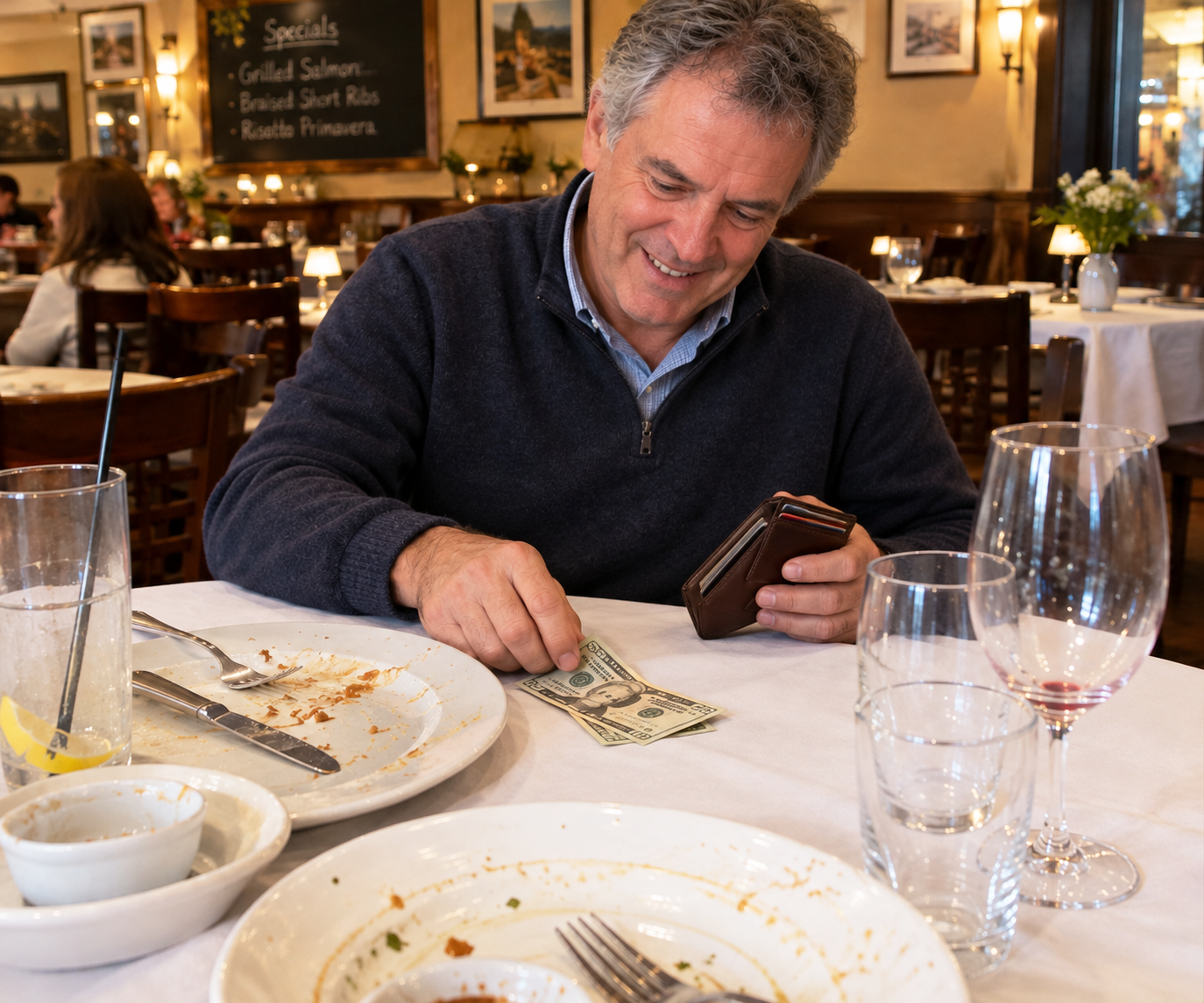
In France, and, indeed, in most of Europe, the scenario is as follows: You study the menu, place an order, say, for a total of 50€. After you eat, you pay 50€, and, if you feel particularly generous or the service was amazingly good, you can leave some change on the table, but this is by no means mandatory. Including taxes and gratuities is much simpler, and I'm not even talking about the fact that a meal that costs 50€ in France would be far more expensive in the United States if one wanted the same quality. So why, then, make things so complicated? |
On this page, we will not discuss the tax situation. In the European Union, there are countrywide value-added tax rates, whereas in the United States, tax rates vary not only by state but are most often a combination of state and local taxes, making a comparison very complicated. Instead, we shall focus on gratuities, a situation that has, according to many, myself included, gotten completely out of hand.
Tipping fatigue in the United States is more than irritation at being asked to add a few dollars to a purchase. It reflects a growing conflict over prices, wages, technology, and the meaning of service. Americans encounter requests for gratuities in situations where the rules once seemed clearer—or where tipping previously seemed unnecessary. A payment terminal turns toward the customer, suggested percentages appear, and an ordinary purchase becomes a small ethical negotiation. Should the customer reward the employee, reject the business's compensation practices, or simply press a button to avoid embarrassment? Digital payment systems have made these encounters more frequent and conspicuous, helping turn a familiar custom into a source of public frustration.
The central issue is ambiguity. A tip can be described as a voluntary expression of gratitude, yet it can also function as an expected contribution to a worker's livelihood. Customers resent feeling responsible for wages; workers reasonably fear losing income; employers operate within a system that allows gratuities to support compensation. Tipping fatigue arises where these competing expectations meet. Understanding it requires looking beyond accusations of customer stinginess or employee entitlement to examine how the system distributes responsibility.
A Custom Without a Shared Rulebook
Americans broadly recognize that tipping expectations have expanded. In a nationally representative survey of 11,945 adults conducted in August 2023, Pew Research Center found that 72 percent believed tipping was expected in more places than five years earlier. Yet only 34 percent said it was extremely or very easy to know whether to tip for different services, and just 33 percent expressed that level of confidence about how much to leave. These findings reveal not simply opposition to tipping, but uncertainty about its boundaries.
That uncertainty matters because tipping depends on shared conventions. When both parties understand an expectation, the transaction can proceed with relatively little friction. When expectations differ, the customer must interpret the situation while the worker may interpret the customer's decision. A gratuity can then become a judgment about generosity, respect, or fairness, even when the customer is merely confused. Tipping fatigue also brings together several distinct complaints. One is the spread of requests into more transactions, sometimes called tip creep. Another is the appearance of higher suggested percentages. A third is the emotional pressure of choosing an amount in front of an employee. These experiences overlap, but they are not identical: someone may willingly tip a restaurant server while objecting strongly to a prompt at a retail counter. University of New Mexico sociologist Eli Wilson describes the expansion into additional retail environments as a central feature of contemporary tip creep.
How the Pandemic Changed Expectations
The COVID-19 pandemic helps explain why tipping became more emotionally charged. During shutdowns and disruptions, some customers used larger gratuities to support workers and businesses under exceptional strain. Tipping for takeout could express solidarity rather than satisfaction with traditional table service. Harvard Business School's Jill Avery describes this behavior as recognition of workers' health risks and the income they lost during closures.
The difficulty came when exceptional generosity began to resemble an ordinary expectation. Customers who had tipped more during an emergency did not necessarily intend to accept a permanent change in the social contract. Businesses and workers, however, could come to depend on income generated under those unusual circumstances. The result was a mismatch between what customers thought they were offering and what the evolving transaction appeared to require.
At the same time, counter service and digital payments became more prevalent. These developments gave businesses a convenient mechanism for requesting gratuities even when the service relationship was brief. Pandemic-era generosity and payment technology therefore reinforced each other: one made additional tipping feel appropriate, while the other made asking for it easy. Avery identifies this combination as an important explanation for the changed tipping landscape.
The Payment Screen as a Social Instrument
A digital tip screen is not merely an electronic version of a tip jar. A jar allows customers to contribute without necessarily making refusal visible. A payment interface requires a decision before the transaction can finish. Even when "no tip" is available, selecting it can feel more deliberate than walking past a container of coins.
Suggested percentages also frame the decision. A screen offering 20, 25, and 28 percent presents a different apparent standard from one offering 10, 15, and 20 percent. Avery explains that these arrangements can nudge customers toward unfamiliar tipping levels by changing the reference points against which an amount seems reasonable. The interface does not have to prohibit a smaller gratuity to influence behavior; it can make that choice feel like a departure from the norm.
The timing creates another tension. When a tip is requested before food or service arrives, it cannot straightforwardly reward the quality of an experience already completed. A customer may instead understand it as support for staff, a routine surcharge, or an uncomfortable test of generosity. The same payment can therefore carry different meanings for different participants. New Jersey State Policy Lab describes the pressure of selecting a gratuity in front of a worker as "guilt tipping." Its discussion links electronic prompts, higher suggested amounts, and the visibility of the decision. This helps explain why customers sometimes resent even modest requests: the objection concerns not only the money but the feeling that a supposedly voluntary payment has become socially difficult to refuse.
Why Higher Prices Intensify the Frustration
Tipping fatigue also concerns the perceived completeness of a price. Customers usually want to know what a purchase will cost before committing to it. A posted price followed by taxes, service charges, and a gratuity request complicates that judgment. Even when each addition has an explanation, the combined experience can feel like discovering the real price in installments. Percentage-based tipping adds another source of friction. If menu prices rise, the dollar value of a tip rises automatically even when the percentage remains unchanged. For example, a 20 percent gratuity on a $20 meal is $4; on a $25 meal it is $5. A simultaneous increase in the suggested percentage produces a second increase. Customers may therefore experience pressure from both the price of the purchase and the expected supplement.
This does not establish that employees are overpaid or that service has become less valuable. It explains why consumers can feel squeezed without becoming less appreciative of workers. Rutgers' analysis places tipping fatigue alongside higher prices and additional service or delivery charges, emphasizing how these demands accumulate in the customer's experience.
The Worker's Side of the Transaction
Any account centered only on customer annoyance misses the stakes for employees. In the United States, tipping is embedded in wage law, not merely etiquette. Under the federal Fair Labor Standards Act, eligible employers can pay tipped employees a direct cash wage of $2.13 an hour while counting tips toward the federal minimum wage of $7.25. If direct wages and tips do not reach that minimum, the employer must make up the difference. Many states require higher direct wages.
These qualifications matter. Saying that every tipped worker earns only $2.13 an hour is inaccurate: that figure is a permitted federal direct wage under specified conditions, not the worker's legally required total compensation. Conversely, saying tips are simply optional bonuses ignores how the tip-credit system incorporates them into minimum-wage compliance. State differences further complicate national arguments about what customers owe.
This arrangement places workers in a vulnerable position when customers protest tipping by withholding gratuities. The customer may intend to send a message to the employer, but the employee can experience the immediate loss. A critique of the compensation system and a decision about an individual worker's tip are therefore related but not interchangeable.
At the same time, it would be a mistake to assume that every worker necessarily wants tipping abolished. The relevant question is what would replace it. A reliable wage, a higher hourly rate, and an uncertain promise of better compensation are not equivalent alternatives. Reform should be judged by employees' actual income and security, not by whether the checkout experience becomes more comfortable.
The Employer's Responsibility
Employers occupy the position most easily obscured by the tipping encounter. The customer sees the employee and the screen, while decisions about pay, prices, and payment settings may be less visible. This encourages a personal confrontation over what is fundamentally an organizational choice. Businesses may have practical reasons to retain tipping, particularly when it contributes to compensation within the legal wage structure. Nevertheless, requesting gratuities does not remove the employer's responsibility to explain prices and pay workers lawfully. Federal law also prohibits employers, managers, and supervisors from keeping employees' tips, subject to the rules governing particular arrangements.
Clarity is especially important when a bill includes a service charge. Under federal labor law, a compulsory service charge is not a tip. Money distributed from such charges may be used to meet wage obligations, but the charge belongs to a different legal category from a voluntary gratuity. A customer therefore cannot safely infer from the words "service charge" alone that the payment is equivalent to a tip received by the server.
A business that communicates poorly about these distinctions invites distrust. Customers should not need to question an employee about payroll arrangements to understand a bill. Clear explanations can reduce confusion even where they do not eliminate disagreement.
What a Less Exhausting System Could Look Like
There is no single reform that resolves every conflict. One approach would preserve tipping while limiting pressure: straightforward suggested amounts, an easily accessible option to decline, and clear explanations of mandatory charges. These changes would not settle the wage debate, but they would make the claim that gratuities are voluntary more credible.
Another approach would incorporate more compensation into posted prices. Its attraction is transparency: customers would encounter a price designed to cover labor rather than being asked to complete the wage calculation themselves. The challenge is ensuring that the transition genuinely protects workers. Eliminating a tip line without providing adequate replacement earnings would solve a consumer irritation at employees' expense.
There is evidence of interest in alternatives, though stated preferences should not be confused with demonstrated purchasing behavior. USA TODAY reported in April 2026 that a Popmenu survey found 56 percent of respondents willing to pay more for meals and beverages if doing so provided higher wages and eliminated gratuities. The same report described substantial frustration with tipping practices. Such findings suggest openness to change, but they do not prove that every restaurant could successfully adopt the same model.
Ultimately, tipping fatigue is a dispute about where the ordinary price ends and the customer's moral responsibility begins. Digital prompts have made that unresolved boundary harder to ignore. A healthier system would neither treat workers' livelihoods as an inconvenience nor assume that every purchase should become an appeal for generosity. Its guiding principle should be understandable prices, dependable compensation, and genuine choice. Gratitude can enrich a service encounter, but it becomes harder to sustain when customers cannot distinguish an invitation to appreciate someone from an obligation to finish paying them.
Home | Site Info | Family | The Area | Trips | France | Work | Rants | Photography | Odds & Ends
This page was last modified on November 1, 2026
Send feedback about this page to feedback@kiechle.com
https://www.kiechle.com/rants/tipping/index.htm
(optimized for Retina display)
All contents © 1999-2026 The Kiechles