The re-election of Emmanuel Macron in April 2022 marked a rare moment in contemporary French political history. Macron became the first French president since Jacques Chirac in 2002 to win a second consecutive term. In the second round of the presidential election, Macron defeated far-right candidate Marine Le Pen, leader of the National Rally (Rassemblement National, RN). While the presidential result appeared to reaffirm the centrist political project that had dominated French politics since 2017, the legislative elections that followed revealed a deeply fragmented political landscape. Macron's coalition lost its absolute majority in the National Assembly, leaving the government without stable parliamentary support. At the same time, two powerful anti-establishment movements—the radical left party La France Insoumise (LFI) led by Jean-Luc Mélenchon and the far-right RN—emerged as dominant forces within the opposition.
The combination of these developments produced an unprecedented situation under the political system of the Fifth French Republic: a presidency forced to govern without a parliamentary majority in a highly polarized political environment. The result has been legislative deadlock, frequent political crises, and a rapid succession of prime ministers. Nevertheless, despite these tensions, the institutional framework of the Fifth Republic has continued to function. The current political period therefore illustrates both the fragility and the resilience of France's constitutional system.
The Executive Structure of the Fifth Republic
To understand the current political situation in France, it is essential to consider the institutional framework of the Fifth French Republic. Established in 1958 under the leadership of Charles de Gaulle, the constitution created a political system designed to ensure executive stability after the governmental instability of the Fourth Republic. In many respects, the institutions of the Fifth Republic were specifically designed to prevent the type of parliamentary fragmentation and governmental instability that characterized the earlier regime. The system is often described as semi-presidential, combining elements of presidential and parliamentary systems. In this framework,
The prime minister proposes the ministers who will compose the cabinet, and these appointments are then formally made by the president. In practice, therefore, the prime minister plays the central role in assembling the government, although this process takes place in close coordination with the president. When the president and the parliamentary majority belong to the same political camp—as has usually been the case since the early 2000s—the president exercises strong influence over both the choice of prime minister and the composition of the government. Nevertheless, the constitutional logic remains that the prime minister leads the government and is accountable for its actions before parliament.
The Fifth Republic has operated under three different political configurations: presidential majority government, cohabitation—when the president must appoint a prime minister from an opposing parliamentary majority—and minority government, the more unstable situation that has characterized much of Emmanuel Macron's second term. Since the constitutional reform of 2000, adopted under President Jacques Chirac, which reduced the presidential term from seven to five years and synchronized presidential and legislative elections, the system has generally produced a presidential majority in the National Assembly, making situations of cohabitation far less likely.
So far, there have been only three cases of cohabitation in the Fifth Republic: from 1986 to 1988, when President François Mitterrand (Socialist Party) appointed Jacques Chirac (RPR Gaullist right) prime minister; from 1993 to 1995 when President François Mitterrand appointed Édouard Balladur (RPR Gaullist right) prime minister; and from 1997 to 2002 when President Jacques Chirac appointed Lionel Jospin (Socialist Party) prime minister. In terms of minority governments, in the 1988 legislative elections, the Socialists and their allies won only 275 seats instead of the 289 needed for a majority; this meant that during the entire second term of François Mitterrand's presidency, France had a minority government, though in those days, there were no truly powerful populist parties, so compromises were easier to reach.
The Legislative Elections of 2022 and the Loss of a Majority
Following Macron's presidential victory in 2022, legislative elections were held in June to elect the 577 members of the National Assembly. These elections produced a dramatic shift in the political balance of power. Macron's coalition—centered around the Renaissance party—remained the largest bloc but fell well short of the 289 seats required for an absolute majority. As a result, the government entered a situation of minority rule.
At the same time, opposition forces achieved significant gains. The left-wing alliance led by LFI consolidated much of the traditional left vote, while the RN obtained the largest parliamentary representation in its history. The National Assembly effectively became divided into three major blocs:
This configuration created a political stalemate. The government could no longer rely on automatic parliamentary support, and opposition parties could potentially combine their votes to defeat government proposals.
Governing Without a Majority
The first prime minister of Macron's second term, Élisabeth Borne, was tasked with governing in this difficult environment. Her government faced immediate challenges in passing legislation. Unlike many European parliamentary systems, France has little tradition of coalition governments. Political parties often prefer to maintain clear ideological identities rather than enter into formal governing alliances. Consequently, the Macron government struggled to build durable partnerships with other parties.
This situation made every major legislative initiative uncertain. For example, budget legislation—essential for the functioning of the state—became a major political battleground. Without a stable majority, the government frequently had to negotiate with smaller groups or rely on constitutional procedures designed to prevent legislative paralysis. The difficulty of governing in such circumstances became particularly evident during debates over pension reform in 2023. The reform, which proposed raising the retirement age, provoked massive demonstrations across the country and intense opposition within parliament.
Article 49.3 and the Passage of Legislation
One of the most controversial tools used by the government during this period has been Article 49.3 of the French Constitution. Article 49.3 allows the government to adopt legislation without a vote in the National Assembly. Once the government invokes this mechanism, the bill is considered adopted unless parliament passes a motion of no confidence against the government. The procedure works as follows:
It is important to note that this parliamentary sanction applies only to the government—that is, the prime minister and the cabinet ministers. Under the constitutional framework of the Fifth French Republic, the president is not politically accountable to parliament and therefore remains in office even when a government falls.
The mechanism was originally designed to strengthen the executive branch and ensure governmental stability by limiting parliamentary obstruction. However, its repeated use during Macron's second term generated intense political controversy. Opposition parties argued that relying on Article 49.3 undermined parliamentary democracy and reduced the role of elected representatives. Nevertheless, from a constitutional perspective, the mechanism functioned exactly as intended: it allowed the government to pass crucial legislation while preserving the possibility for parliament to remove the government through a confidence vote.
The Role of La France Insoumise
La France Insoumise has played a central role in shaping the parliamentary dynamics of Macron's second term. Founded by Jean-Luc Mélenchon, the movement represents a radical left alternative to traditional social-democratic parties. LFI advocates an ambitious political program including
In parliament, LFI deputies have often adopted a confrontational strategy. They regularly challenge government legislation, use procedural tactics to slow debates, and present themselves as the main opposition force defending social rights and public services. LFI's refusal to cooperate with Macron's centrist coalition significantly limits the government's ability to build parliamentary support. Because the party views Macron's economic policies as fundamentally incompatible with its own platform, compromise between the two camps remains rare.
The Rise of the National Rally
On the opposite side of the political spectrum, the National Rally has experienced a remarkable transformation in recent years. Historically associated with the far-right political tradition founded by Jean-Marie Le Pen, the party has attempted to broaden its appeal under the leadership of his daughter, Marine Le Pen. Le Pen's strategy has focused on "normalizing" the party's image and presenting it as a credible governing alternative. While the RN continues to advocate strict immigration policies, economic protectionism, and strong national sovereignty, it has softened some of its earlier positions in order to attract a wider electorate.
The legislative elections of 2022 marked a turning point for the RN. For the first time, the party obtained a large and influential parliamentary group. This presence allows RN deputies to participate actively in legislative debates and influence parliamentary votes. Although RN and LFI are ideological opponents, their shared opposition to Macron occasionally leads them to vote together on procedural matters, particularly motions of no confidence. This dynamic creates a constant risk for minority governments.
Early Legislative Elections and the Emergence of a Three-Bloc System
Political tensions intensified further when President Macron decided to dissolve the National Assembly and call early legislative elections in 2024. Dissolution is a constitutional power of the president and is intended to resolve political deadlock by appealing directly to voters. However, this once again produced a fragmented parliament. Instead of clarifying the political balance, the elections reinforced the tripolar structure of French politics. Three large blocs—centrist, left-wing, and far-right—continued to divide the Assembly without any one of them achieving a majority. This outcome made government formation extremely difficult and contributed to a period of rapid political turnover.
The Unprecedented Succession of Prime Ministers
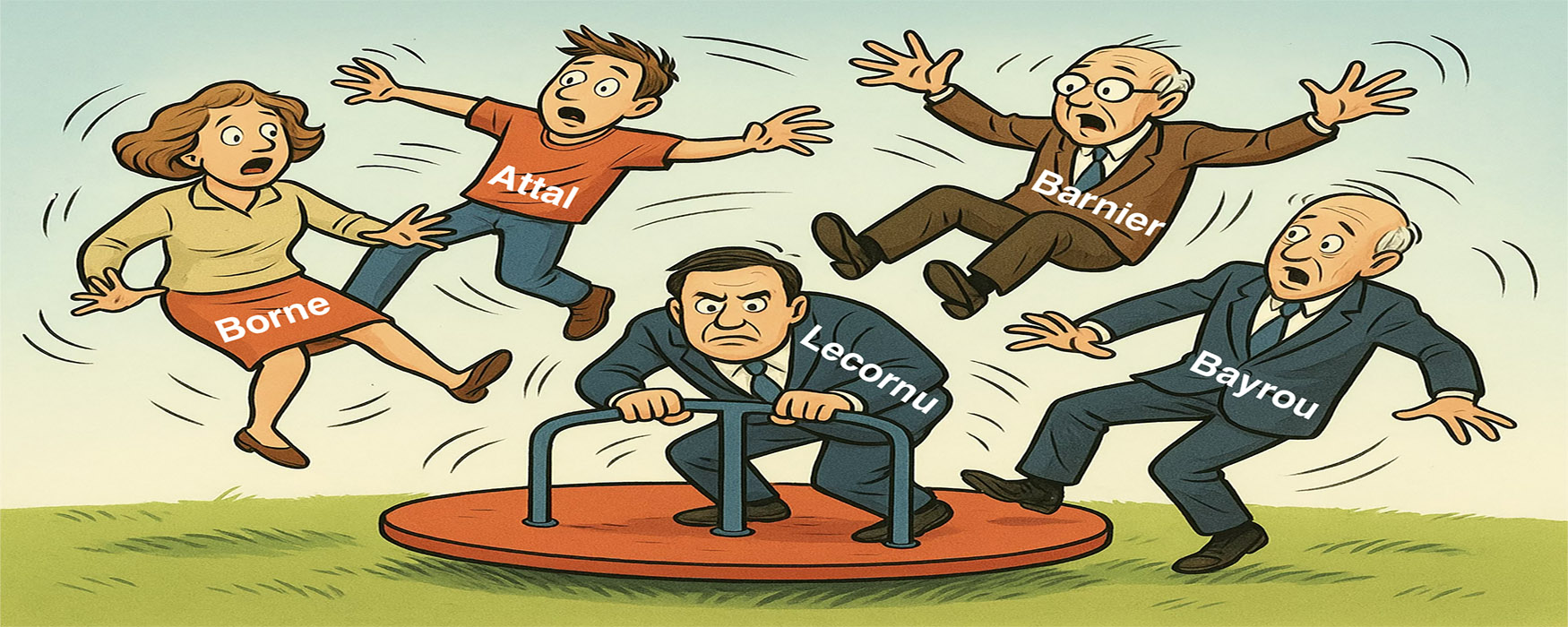
The unstable parliamentary situation led to an unusual succession of prime ministers during Macron's second term. The first prime minister after the 2022 presidential election was Élisabeth Borne, who had to govern without a parliamentary majority following the legislative elections of that year. Borne remained in office throughout a particularly difficult period marked by the controversial pension reform of 2023 and repeated reliance on Article 49.3 of the French Constitution to pass key legislation. Her government faced continuous political pressure from both the radical left and the far right, as well as growing fatigue within the president's own political camp.
In January 2024, President Emmanuel Macron replaced Borne with the younger and more politically dynamic Gabriel Attal. At 34, Attal became the youngest prime minister in the history of the Fifth Republic. His appointment was widely interpreted as an attempt by Macron to refresh the government's image and regain political momentum ahead of upcoming elections. However, Attal's tenure did not fundamentally resolve the structural problem facing the government: the absence of a stable parliamentary majority. Political tensions remained high, and the fragmented composition of the National Assembly continued to complicate the passage of legislation. Following the European elections of 2024, in which the far-right National Rally achieved a major victory, Macron decided to dissolve the National Assembly and call early legislative elections. This decision marked a turning point in the political crisis and opened a new phase of instability. The elections produced an even more fragmented parliament, reinforcing the three-bloc structure of French politics and contributing to further governmental turnover in the months that followed. As a result, several additional prime ministers were appointed (as of March 2026):
Some governments lasted only a few months before collapsing after parliamentary confrontations, particularly over budget legislation. This rapid turnover is highly unusual for the Fifth Republic, which was designed to avoid the frequent government changes that plagued the Fourth Republic. The succession of prime ministers reflects the difficulty of governing a country where the executive branch lacks stable parliamentary support.
Institutional Resilience
Despite repeated crises, the institutions of the Fifth Republic have continued to function. Several structural factors explain this resilience:
Conclusion
The period following the re-election of Emmanuel Macron in 2022 has been one of the most politically complex in the history of the Fifth Republic. The loss of a parliamentary majority, the rise of powerful opposition forces on both the left and the right, and the fragmentation of the political system have created a difficult environment for governance.
The presence of powerful anti-establishment parties, such as La France Insoumise and the National Rally, has transformed French politics into a three-bloc system in which no single group can dominate parliament. This configuration has led to legislative deadlock, frequent confidence crises, and an unusual succession of prime ministers.
The situation has important implications for the presidential election scheduled for 2027. Because the constitution of the Fifth French Republic limits Emmanuel Macron to two consecutive terms, the next election will take place without an incumbent candidate, increasing uncertainty about the future balance between the centrist bloc, the radical left represented by La France Insoumise, and the far-right National Rally.
Nevertheless, the institutional framework of the Fifth Republic has demonstrated remarkable resilience. Presidential authority, constitutional safeguards, and administrative continuity have allowed the French state to continue functioning despite intense political conflict. The current situation therefore represents a major test for France's political institutions. Whether the system can adapt to this new era of fragmentation will play a decisive role in shaping the future of French democracy.
Cannes, France
March 2026
Home | Site Info | Family | The Area | Trips | France | Work | Rants | Photography | Odds & Ends
This page was last modified on April 1, 2026
Send feedback about this page to feedback@kiechle.com
https://www.kiechle.com/rants/french-mess/index.htm
(optimized for Retina display)
All contents © 1999-2026 The Kiechles